Kevin Burns
Developer Advocate @ Uber
View all authors

Encrypt Cadence History Payloads (And Know What You Didn't Encrypt)

· 4 min read
Kevin Burns
Developer Advocate @ Uber

You encrypted the payloads. Here is what you did not encrypt.

The AES-256-GCM DataConverter makes every workflow input, activity result, signal payload, and query response opaque to anyone without your key. That is the good part. The less obvious part: several Cadence data surfaces sit entirely outside the DataConverter path, and they are still plaintext regardless of what your converter does.
Bypass the 2 MB Limit Without Shrinking Your Workflow

· 3 min read
Kevin Burns
Developer Advocate @ Uber

The 2 MB per-payload limit in Cadence does not come with a helpful error. Your workflow does not receive a graceful degradation notice. It just fails. And if you have never hit the limit before, the stack trace is not obvious about what happened.

The claim-check pattern solves this completely. Instead of compressing a large payload and hoping it fits, you offload it to an external blob store and write only a small reference into Cadence history. The limit no longer applies to your payload; only to the reference, which is always tiny.

Your Workflow History Is Storing More Than You Think

· 3 min read
Kevin Burns
Developer Advocate @ Uber

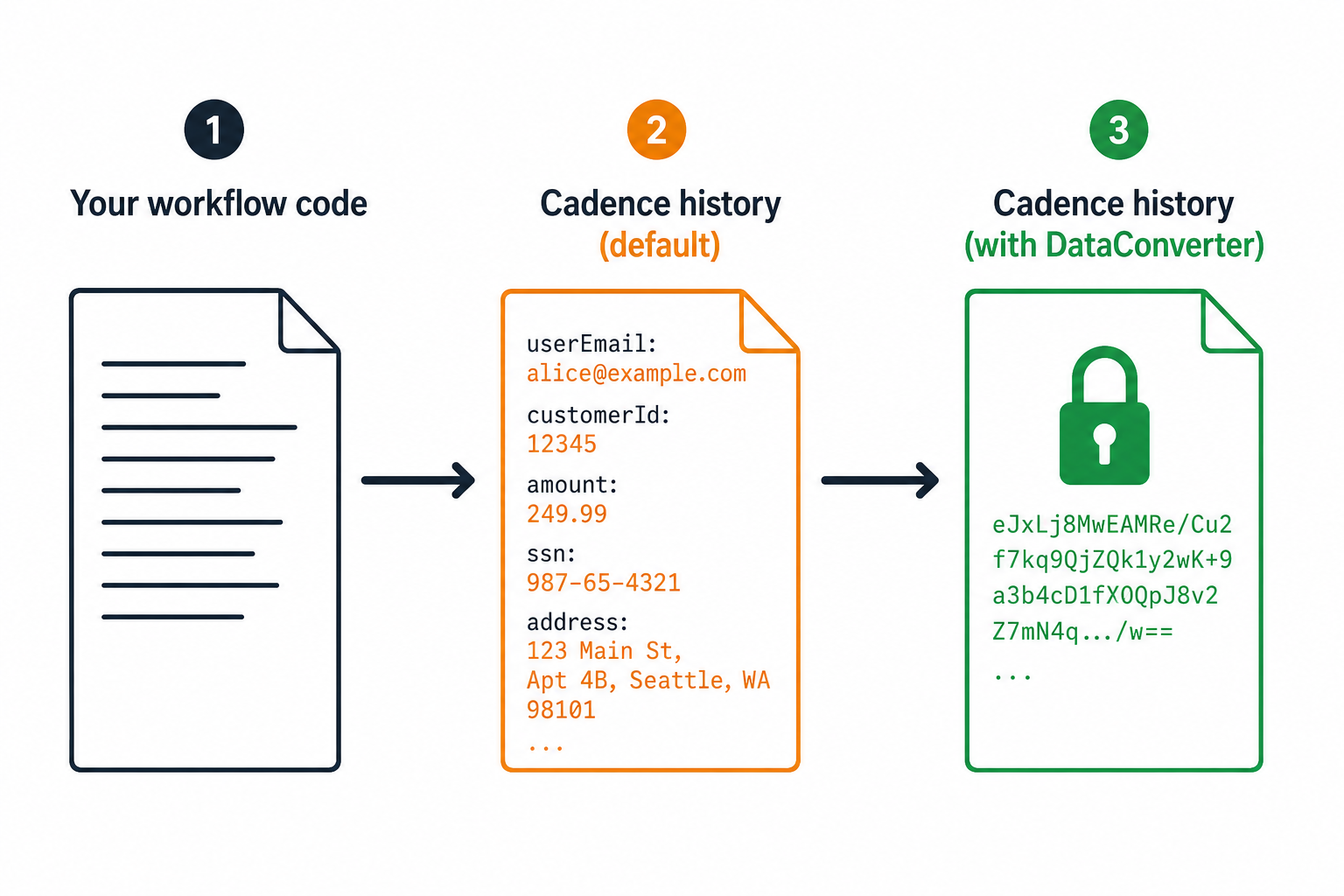
That customer order you passed into your fulfillment activity (the one with the email address, the shipping details, and the internal pricing fields) is sitting in your workflow history as plaintext JSON right now. Anyone with read access to Cadence history can see it. So can anyone with access to your history storage backend. Data pipeline: workflow history exposed vs. protected with DataConverter This is not a bug. It is how Cadence works by design, and it is the right default for most workloads. But three problems follow from it in production, and most teams hit at least one of them before they know the solution exists.

Introducing Batch Future with Concurrency Control

· 6 min read
Kevin Burns
Developer Advocate @ Uber

Are you struggling with uncontrolled concurrency when trying to process thousands of activities or child workflows? Do you find yourself hitting rate limits or overwhelming downstream services when running bulk operations? We've got great news for you!

Today, we're thrilled to announce Batch Future, a powerful new feature in the Cadence Go client that provides controlled concurrency for bulk operations. You can now process multiple activities in parallel while maintaining precise control over how many run simultaneously.